The order we’ve built isn’t the goal
Walk into most classrooms today and something is different. Students are settled. Expectations are clear. Routines are in place. There’s a kind of quiet that schools used to fight for — and now, in many places, have.
That didn’t happen by accident. Positive behaviour frameworks — PBL, PBS, PBIS — have done real work. They’ve made classrooms calmer, safer, more predictable. And alongside them, teaching has sharpened. For anyone who remembers what some of these classrooms looked like ten years ago, the change is remarkable.
But the order we’ve created isn’t the goal. It’s the starting point.
Once the room is settled, ready for what?
Ready to learn — but becoming a learner?
Ready to learn. But learning isn’t the end of the conversation. Students can be learning content — following instructions, completing tasks, meeting the standard — and still not be becoming better learners. That’s the gap we need to close. Not between chaos and order; we’ve done that work. The gap is between learning and becoming a learner.
There’s a simple way to describe it — the Learning Equation. Growth = Skilful Teaching × Skilful Learning. Not addition, but multiplication, which means that if either side is missing, the result collapses. For the last decade, schools have invested heavily on the left-hand side — the quality of teaching, instructional practice, and the behaviour systems that support teachers to teach. We should be proud of that work. But the right-hand side has been assumed. We’ve assumed that if teaching is good enough, learning will follow. For some students it does. For most — especially the ones who have quietly drifted into compliance — it doesn’t. Not reliably, and not once the teacher is no longer beside them.
Skilful teaching deserves a partner. That partner is skilful learning. And skilful learning has a name: Learnership.
What PBL was never designed to do
Let me be clear: I’m not arguing against PBL. Done well, it’s one of the most important shifts schools have made in decades. It solves a real problem, and it creates the conditions under which learning can happen.
But PBL was never designed to develop learners. It was designed to shape behaviour. When we ask a behavioural framework to do the work of building skilful learners, we’re using the wrong tool for the job. That’s not a criticism — it’s a matter of scope. PBL clears the ground. What happens on that ground is a different kind of work. And in many schools that work gets skipped, not by design but by default — the assumption creeps in that if students are settled and following instructions, learning will take care of itself. It won’t.
“But won’t behaviour slip?”
I hear this from schools that have worked hard to embed PBL. The worry is understandable: if we shift our attention to Learnership, will the behavioural gains start to erode?
No — because Learnership isn’t a replacement for PBL. It’s a second layer that sits on top of it. PBL keeps doing its job. Routines stay consistent, expectations stay clear. What changes is what we do with the conditions PBL creates: rather than stopping at “the class is ready,” we move to “now let’s develop them as learners.” If anything, the work strengthens the behavioural gains — students who know how to engage with challenge have fewer reasons to disengage from it.
The two layers don’t compete. They compound.
Motivation is an output, not an input
Many schools describe a motivation problem. Students disengage, give up quickly, wait to be rescued. The instinctive response is to make learning more engaging — more fun, more interactive. But that treats the symptom, not the cause. Motivation rarely comes before doing. It comes through doing — through experiencing progress, seeing effort produce results, noticing yourself become more capable. Motivation is best understood as a lagging indicator of Learnership. When students have the skills of learning, motivation tends to follow. When they don’t, no amount of polish on the activity will fix it.
From compliance to capability
Compliance is what students do when the conditions are easy and the direction is clear. Capability is what they do when the conditions are difficult and the path isn’t obvious. A compliant classroom can look wonderful and still produce students who stall the moment they’re asked to think for themselves.
Most schools have got good at getting students ready to learn. That’s worth celebrating — it was hard-won. But it was always meant to be a means, not an end. The real question isn’t whether students behave well when things are easy. It’s whether they have what it takes when things get hard. Whether they can become masters of their circumstances, not victims of them. And that doesn’t happen by accident. It happens when we decide to teach it.
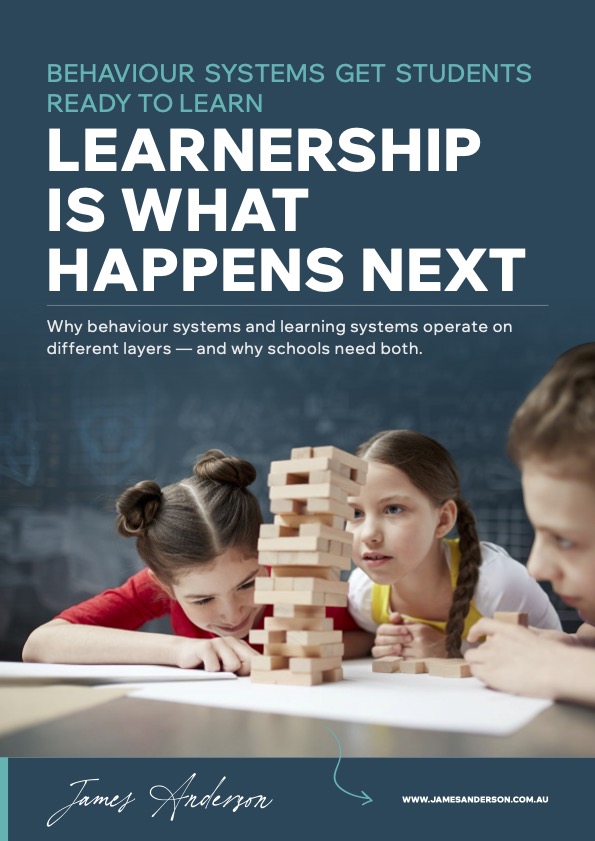
The white paper sets out why behaviour systems and learning systems operate on different layers — and how to build the second one on the foundation the first one creates.